Table Of Content
If the kids do better on the second test, you might conclude that the program works. If our lineup of research designs were like players on a basketball court, Multivariate Design would be the player dribbling, passing, and shooting all at once. This design doesn't just look at one or two things; it looks at several variables simultaneously to see how they interact and affect each other. The Crossover Design has its roots in medical research and has been popular since the mid-20th century.
Sampling methods
The key difference between observational studies and experiments is that, done correctly, an observational study will never influence the responses or behaviours of participants. Experimental designs will have a treatment condition applied to at least a portion of participants. How precisely you measure your dependent variable also affects the kinds of statistical analysis you can use on your data. Finally, you need to decide how you’ll collect data on your dependent variable outcomes.
Experimental Design Examples (Methods + Types)
When testing a theory or new product, it can be helpful to have a certain level of control and manipulate variables to discover different outcomes. You can use these experiments to determine cause and effect or study variable associations. Regression analysis is used to model the relationship between two or more variables in order to determine the strength and direction of the relationship. There are several types of regression analysis, including linear regression, logistic regression, and multiple regression. Descriptive statistics are used to summarize and describe the data collected in the study. This includes measures such as mean, median, mode, range, and standard deviation.
Sequences of experiments
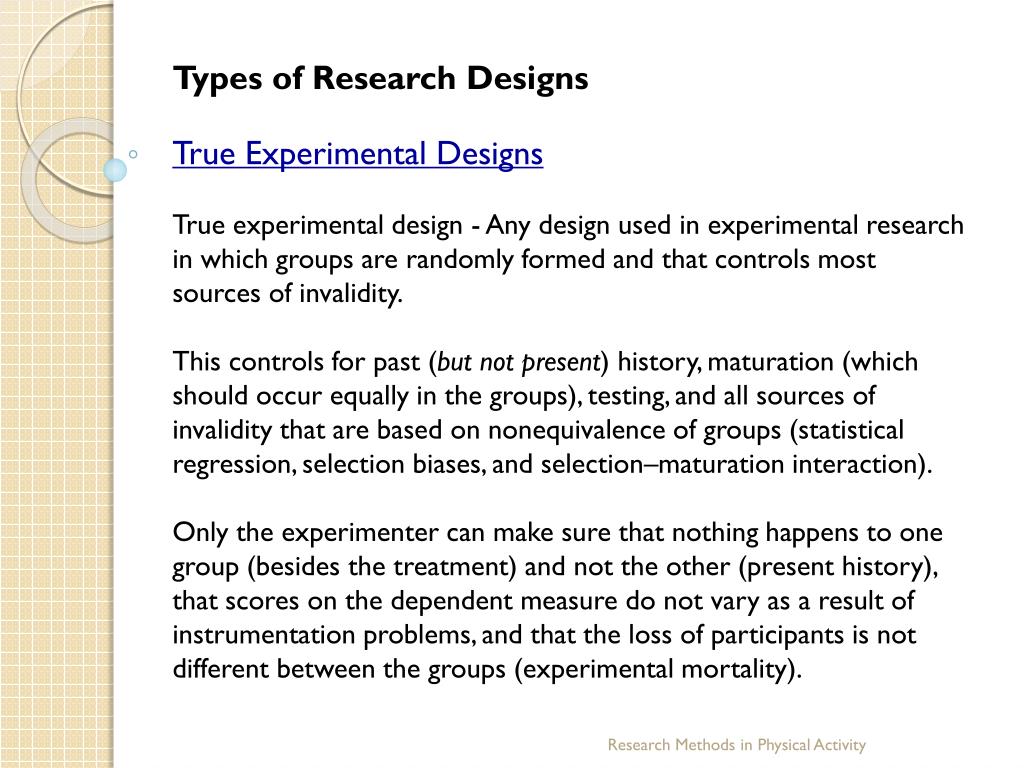
For example, a standard treatment in substance abuse recovery is attending Alcoholics Anonymous or Narcotics Anonymous meetings. A substance abuse researcher conducting an experiment may use twelve-step programs in their control group and use their experimental intervention in the experimental group. The results would show whether the experimental intervention worked better than normal treatment, which is useful information. When subjects are divided into control groups and treatment groups randomly, we can use probability to predict the differences we expect to observe. If the differences between the two groups are higher than what we would expect to see naturally (by chance), we say that the results are statistically significant.
Types of Experimental Research Designs
Because the study is happening in a real school with real students, the results could be very useful for understanding how the change might work in other schools. But since it's the real world, lots of other factors—like changes in teachers or even the weather—could affect the results. On the other hand, the lack of control can make it harder to tell exactly what's causing what.
Adaptive Designs are like the agile startups of the research world—quick to pivot, keen to learn from ongoing results, and focused on rapid, efficient progress. However, they require a great deal of expertise and careful planning to ensure that the adaptability doesn't compromise the integrity of the research. Now, let's talk about Adaptive Designs, the chameleons of the experimental world. One famous use of Pretest-Posttest Design is in evaluating the effectiveness of driver's education courses. Researchers will measure people's driving skills before and after the course to see if they've improved. Pretest-Posttest Design checks out what things are like before the experiment starts and then compares that to what things are like after the experiment ends.
However, it requires careful planning and expertise to ensure that these "stop or go" decisions are made correctly and without bias. This allows for a more efficient use of resources, as you're only continuing with the experiment if the data suggests it's worth doing so. Firstly, it allows for the study of interventions that are expected to do more good than harm, which makes it ethically appealing.
Insufficient or Incorrect Statistical Analysis
Researchers might have participants follow a low-carb diet for a few weeks, then switch them to a low-fat diet. By doing this, they can more accurately measure how each diet affects the same group of people. The neat thing about this design is that it allows each participant to serve as their own control group.
Repeated Measures Design Cons
Laboratory experiments are conducted under controlled conditions, which allows for greater precision and accuracy. However, because laboratory conditions are not always representative of real-world conditions, the results of these experiments may not be generalizable to the population at large. In a within-subjects design, each participant experiences all conditions, and researchers test the same participants repeatedly for differences between conditions. In a between-subjects design, every participant experiences only one condition, and researchers assess group differences between participants in various conditions. A confounding variable is related to both the supposed cause and the supposed effect of the study. It can be difficult to separate the true effect of the independent variable from the effect of the confounding variable.
Some theory on experimental design…with insight into those who run them - World Bank
Some theory on experimental design…with insight into those who run them.
Posted: Wed, 20 Apr 2016 07:00:00 GMT [source]
The researchers recorded their speed, breathing rates, and level of exhaustion. Will the type of movie a person watches affect the likelihood that they donate to a charitable cause? To answer this question, a researcher decides to solicit donations at the exit point of a large theatre.
Product design testing is an excellent example of experimental research. Researchers must ensure their experiments do not cause harm or discomfort to participants. Depending on your experiment, your variable may be a fixed stimulus (like a medical treatment) or a variable stimulus (like a period during which an activity occurs). This structure requires the researcher to divide participants into two random groups. One group receives no stimuli and acts as a control while the other group experiences stimuli. This method includes two or more groups, enabling the researcher to use one group as a control.
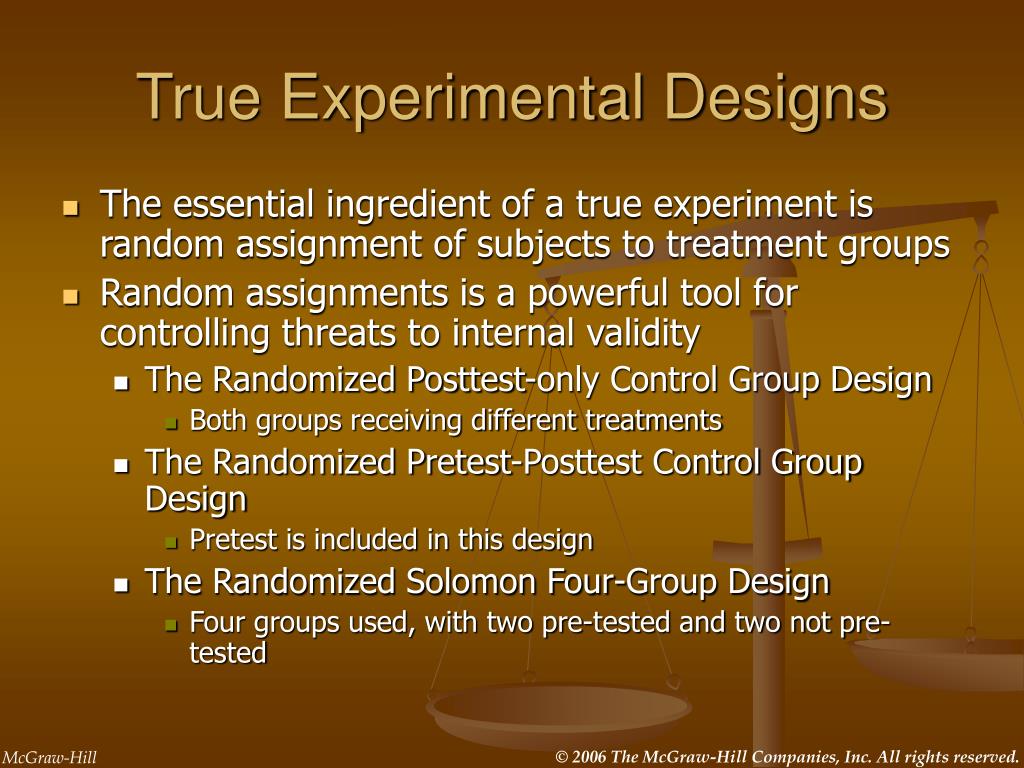
The first two of these groups are tested using the posttest-only method, while the other two are tested using the pretest-posttest method. In a static-group comparison study, 2 or more groups are placed under observation, where only one of the groups is subjected to some treatment while the other groups are held static. All the groups are post-tested, and the observed differences between the groups are assumed to be a result of the treatment. You should anticipate and incorporate those limitations into your conclusion, as well as the basic research design.
As well as choosing an appropriate sampling method, you need a concrete plan for how you’ll actually contact and recruit your selected sample. But often you’ll be dealing with more abstract concepts, like satisfaction, anxiety, or competence. Operationalisation means turning these fuzzy ideas into measurable indicators. Using secondary data can expand the scope of your research, as you may be able to access much larger and more varied samples than you could collect yourself. To make the research more manageable, and to draw more precise conclusions, you could focus on a narrower population – for example, Year 7 students in low-income areas of London. The more precisely you define your population, the easier it will be to gather a representative sample.
Understanding these terms will make it easier for us to explore the various types of experimental designs that researchers use to answer their big questions. The independent variables are the experimental treatment being exerted on the dependent variables. Extraneous variables, on the other hand, are other factors affecting the experiment that may also contribute to the change.
Not all kinds of experimental research can be carried out using simulation as a data collection tool. It is very impractical for a lot of laboratory-based research that involves chemical processes. It measures and observes the variables of interest without changing existing conditions. Only one group of carefully selected subjects are considered in this research, making it a pre-experimental research design example. We will also notice that tests are only carried out at the end of the semester, and not at the beginning. This website is using a security service to protect itself from online attacks.


No comments:
Post a Comment